January, February, and March get lumped together as "the dead months" by most cycling guides — book in April instead, they say. From where we guide rides in Mallorca, that verdict is only true for one of these three months, and it isn't the one people think.
Quick answer
- January is the coolest, quietest month of the year to ride — genuinely good conditions on most days, but mornings in the mountains can sit close to freezing, and this is peak pre-season training-camp season on the island.
- February rides like January with one major addition: Mallorca's almond blossom, usually at its best in the second half of the month, turning the interior valleys around Selva and Caimari white and pink.
- March is the reopening hinge — the reverse of November: mountain-village hotels start coming back online, days lengthen, and climbs like Sa Calobra and Puig Major become genuinely comfortable again, though weather is still the least predictable of the three months.
- Across all three months: the lowest hotel and rental rates of the year, empty roads, and — uniquely to this window — the chance to ride the same interior roads Mallorca's winter training-camp visitors use.
What actually changes between January and March
The same trap applies here as with any "best time to visit" piece: average the whole quarter into one verdict and you lose the thing that actually matters. January and February are close cousins — both are Palma-based, both are quiet, both sit in the coolest stretch of the year. March is a genuinely different trip: it's the month things start reopening, the point where you can credibly plan a route that leaves Palma behind for a few days. If you're choosing between these three months, the honest dividing line isn't "which is warmest" — it's "do you want the almond blossom (book February) or do you want more of the island back on the table (book March)."
January: the quietest month on the whole calendar
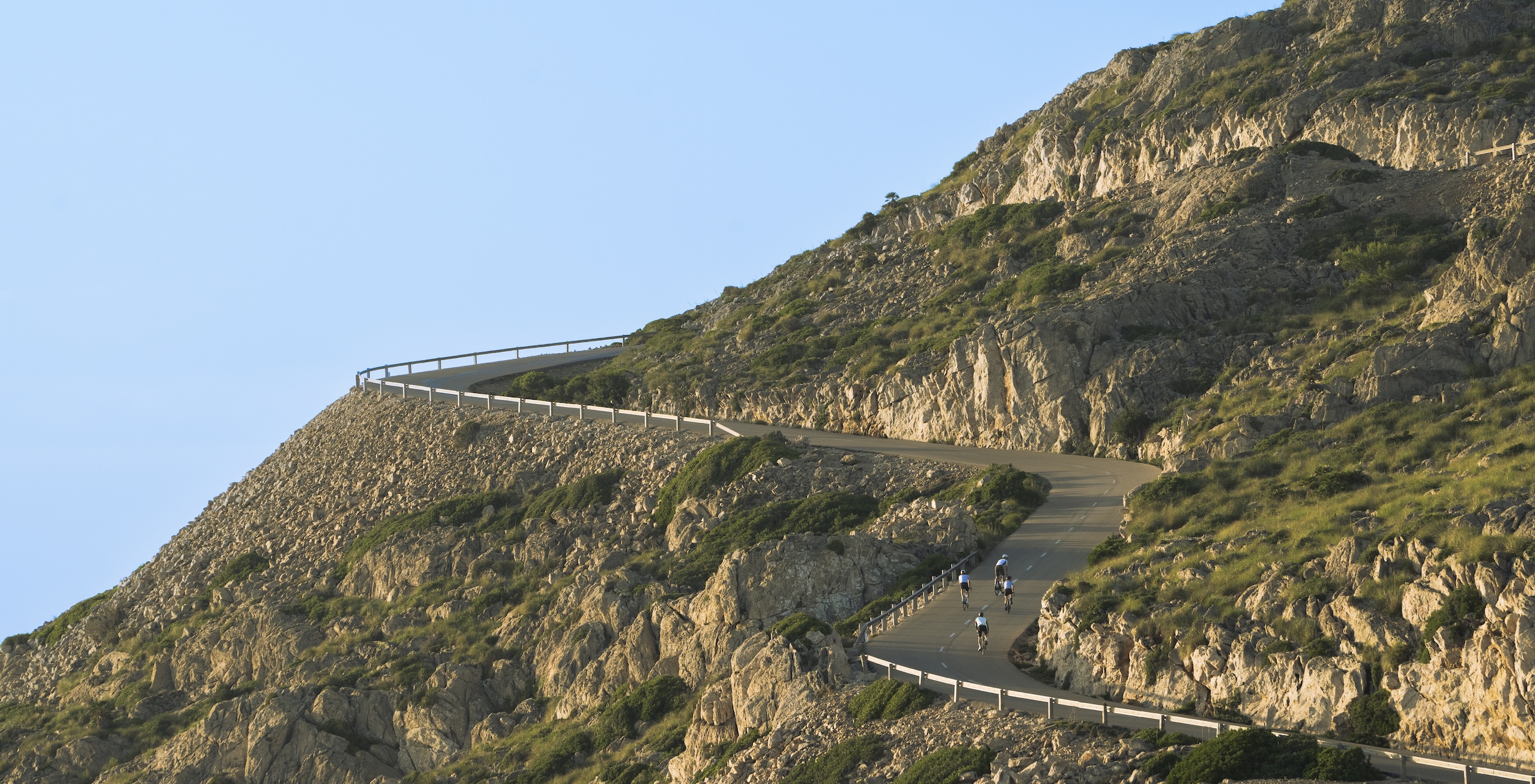
January is Mallorca's coldest and quietest cycling month, and it rides that way: near-empty roads, low winter light that makes the Tramuntana look genuinely dramatic, and daytime temperatures that are comfortable for riding as long as you dress for a cool start. The real caution is at altitude and early in the day — mountain mornings can sit close to freezing, especially in the shaded gorges on the way up to climbs like Puig Major, so this is not a month to underdress or set off before the sun has properly hit the road. This is also when much of the island's mountain-village hotel roster is still closed for the season — the same closures that started in mid-November are still in effect, so Palma remains the only genuinely reliable base. What most first-time visitors don't know: January is also when a meaningful number of professional cycling teams choose Mallorca for early pre-season training camps, drawn by the same mild, quiet, low-traffic roads you'd be riding. You'll likely share a café stop or a climb with a WorldTour team and not immediately realise it.
February: the almond blossom month
February rides almost exactly like January — same Palma base, same quiet roads, same training-camp company on the climbs — with one addition that, on its own, is worth booking this specific month for: Mallorca's almond blossom. The island has one of the largest concentrations of almond trees in the Mediterranean, and for a few weeks that usually fall in the second half of February, the interior valleys below the Tramuntana — the farmland around Selva, Caimari, and the wider Es Raiguer belt — turn white and pale pink for as far as you can see. It's the single most photographed natural event on the island outside of a sunset over Sa Calobra, and almost no cycling guide mentions it, because it isn't a fixed date on a calendar — it depends on the winter's weather, and it can arrive slightly earlier or later from year to year. Riding through it is genuinely different from seeing it from a car: you smell it before you see the next valley, and the roads through it — quiet farm lanes rather than the famous coastal climbs — are some of the least-ridden tarmac on the island the rest of the year.
March: the reopening hinge
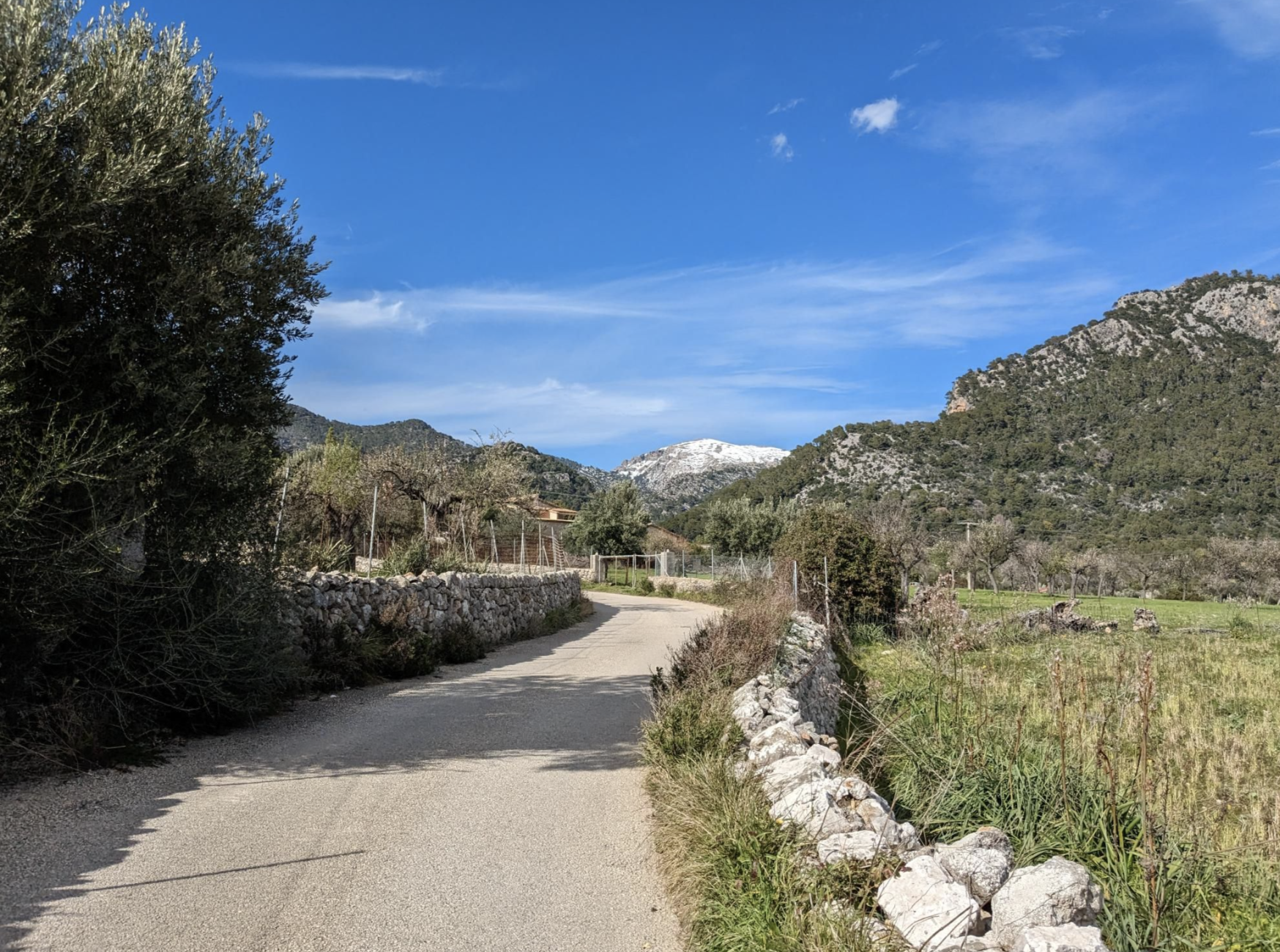
If November is the month everything starts closing for the season, March is its mirror image: this is when mountain-village hotels start reopening ahead of the April rush, progressively rather than all at once, so it's worth checking a specific property before assuming it's open. The trade-off is weather — March is genuinely the least predictable of the three months, with rain systems that can roll through the Tramuntana with little warning and mountain temperatures that sit noticeably lower than the coast, so pack layers you're prepared to actually use. What you get in return: as the mountain villages reopen and daylight stretches, roads that were impractical to base a trip around in January and February — Sa Calobra and Puig Major chief among them — come back into genuine reach, and you can ride them with a fraction of the coach and rental-car traffic they'll see from April onward. It's also, not coincidentally, when many of the professional teams training on the island in January and February shift their own focus toward early-season form, which is a useful signal: if March conditions are good enough for a WorldTour training block, they're good enough for yours.
January, February, and March at a glance
| Factor | January | February | March |
|---|---|---|---|
| Hotel availability | Narrow — Palma is the reliable base | Narrow — Palma is the reliable base | Widening — mountain hotels reopen progressively |
| Recommended base | Palma | Palma, or the interior for the almond blossom | Palma or a reopened mountain base — check the property first |
| Crowds on the road | Essentially empty | Essentially empty | Still quiet, building slightly toward April |
| Prices vs. summer | Lowest of the year | Lowest of the year | Still well below summer, starting to firm up |
| Typical start time | Later morning — let the frost clear at altitude | Later morning, similar to January | Flexible — build the day around the forecast, not the clock |
| Restaurant reservations | Rarely needed | Rarely needed | Rarely needed |
| Weather risk | Moderate — cold mountain mornings, not much rain | Moderate — similar to January | Highest of the three — rain systems can move in fast |
| Extra draw | Riding alongside pre-season training camps | Almond blossom across the interior valleys | Sa Calobra and Puig Major back in reach, before the April crowds |
Where to base yourself: Palma, and the interior for the blossom
The logic carried over from autumn still holds through most of this window: with the mountain-village hotel roster thin until March, Palma sits at the foot of the southern Serra de Tramuntana and puts real, varied climbing within easy reach without a long transfer — Andratx, Galilea, Establiments, Valldemossa, and Banyalbufar all still work exactly as they do in the autumn months we've covered in our guide to riding Mallorca in October, November and December, which goes deep on the specific climbs from a Palma base if you haven't read it.
For the interior itself — the almond country, and the roads up to Santuari de Cura (4.7 km at 5.5% up Puig de Randa, an isolated hill in the island's centre with a historic monastery and genuinely panoramic views at the summit) — a Palma base still works, but riders who want to wake up inside the blossom rather than ride out to it have a real alternative: Finca Binibona, a 4-star rural hotel in the foothills near Selva with secure bike storage and a kitchen used to feeding cyclists, sits inside the almond belt itself and puts you at the base of Coll de Sa Batalla (7.9 km at 5.0% from Caimari) without any transfer at all.
Riding alongside pro cycling's pre-season
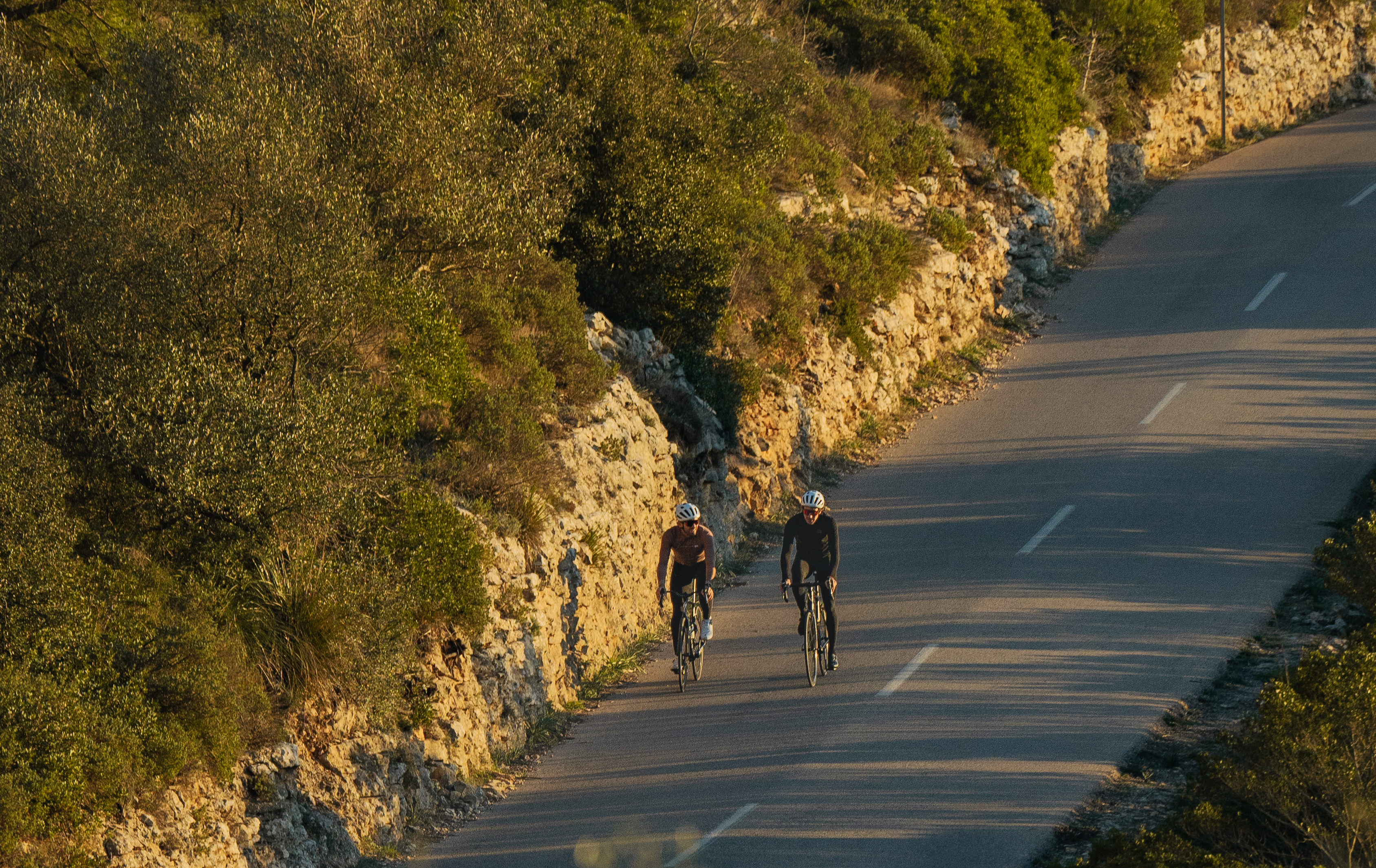
Mallorca's winter climate is mild enough, and its roads quiet enough, that a meaningful slice of the professional peloton chooses the island for early pre-season training blocks through January and February — one of the reasons the island stays lively even in its quietest months, and one of the more surprising reasons to actually want to ride here in winter rather than despite it. Late January also brings a genuine professional stage race to the island, the Challenge Ciclista de Mallorca, which briefly puts a WorldTour peloton on some of the same roads you'll be riding — worth knowing about mainly because it means road closures and slightly tighter hotel availability around Palma for that specific week, not because it changes the rest of the window. If riding some of the same inland roads pro riders use for winter base fitness appeals to you, our guide to Remco Evenepoel's heartland training routes in Mallorca maps out exactly where.
What about the weather?
Worth being straight about this rather than selling a fantasy: January through March is Mallorca at its coolest, and March specifically is genuinely the least predictable weather-wise — rain systems can move through the Tramuntana with little warning, and mountain temperatures often sit noticeably lower than whatever you're feeling on the coast. January and February are more settled than March in practice, but colder, especially at altitude in the early morning. None of this rules out riding; it means building flexibility into your daily start time and route rather than committing to a fixed plan the night before, and packing a genuine rain and wind layer rather than assuming you won't need it. Most days in this window still open into real, rideable windows, often with the kind of dramatic winter light over the Tramuntana that the crowded months never produce.
The other real advantages of riding Q1
A few things are easy to underrate about this window until you've actually ridden it against a July or August trip:
- The lowest prices of the year. Hotel and rental rates in January and February sit at their annual floor, before March starts firming back up ahead of the spring season.
- Roads that belong to you and the training camps. No coach tours, no rental-car traffic on the coastal roads — the closest thing to crowding you'll see is another cycling team out doing exactly what you're doing.
- No restaurant chasing. Walking into a good table in Palma the same evening is the norm through this entire window, not the exception.
- A once-a-year event. Unlike the quiet-but-similar autumn months, February adds something you can't get any other time of year: the almond blossom. Miss the window and it's a twelve-month wait.
Frequently Asked Questions
Is it too cold to cycle in Mallorca in January or February?
No, but dress for it. Daytime temperatures are comfortable for riding, but mountain mornings can sit close to freezing, especially in shaded gorges — start later rather than earlier, and carry a proper layer for descents. As a rule of thumb, treat the Tramuntana as noticeably colder than Palma at the coast, particularly with any wind, so a windproof gilet earns its place in a jersey pocket even on a day that looks sunny from your hotel window.
When is the best time to see the almond blossom in Mallorca?
Most years, the almond blossom peaks in the second half of February across the interior valleys around Selva, Caimari, and the wider Es Raiguer region — though the exact timing shifts with that winter's weather, so it can arrive a little earlier or later.
Do mountain-village hotels in Mallorca reopen by March?
Many start to, though it happens progressively through the month rather than all at once — properties around Sóller, Fornalutx and Pollença town are typically among the first back online — so it's worth checking a specific property before booking around it. January and February are still Palma-based months for most visitors.
Why do professional cycling teams train in Mallorca in the winter?
Mild winter temperatures, quiet roads, and reliable riding conditions make the island a popular choice for early pre-season training camps through January and February, including around the Challenge Ciclista de Mallorca stage race in late January. Many teams use this window for base miles, then sharpen into more intensity as March lengthens the days — a rhythm worth borrowing for your own trip.
Is March a good month to ride Sa Calobra or Puig Major?
Yes — as mountain hotels reopen and daylight lengthens, both become genuinely comfortable again, with a fraction of the coach and rental-car traffic they see from April onward. Weather is the trade-off: March is the least predictable of the three months, so build flexibility into your plans.
Are the iconic climbs like Sa Calobra and Puig Major actually open in winter?
Yes. Neither road closes for the season — Sa Calobra and the climb up from it are rideable year-round, and Puig Major's cycling road stays open too, aside from the rare short closure for snow, ice or roadworks at altitude (the summit itself remains a military area, as it does all year). After heavy rain or a strong Tramuntana wind, it's worth checking conditions before committing to an exposed descent, but neither climb is seasonal the way the hotels are.
How often does it actually rain during this window?
More than in high summer, but rarely as a write-off. Expect a handful of rain days across a week-long trip, usually short, sharp bursts rather than all-day washouts. Building a café stop and a shorter backup loop into your plan means a 40-minute shower doesn't have to end your riding day.
What should I pack for cycling in Mallorca in January, February or March?
Think layers rather than heavy winter kit: a windproof, water-resistant jacket, arm and leg warmers, a light gilet, full-finger gloves, and a thin thermal base layer cover most days. On a sunny winter morning it's easy to overheat on the way up a climb and get cold fast on the descent, so kit you can add and remove on the move matters more here than in any other season.
Do I need to worry about bike shops or rentals being closed?
Not with Medfeel — your bike is fitted to your measurements before you arrive and delivered to your first hotel, so this isn't something you need to plan around. If you're travelling independently, it's worth knowing that low season brings shorter hours and the occasional closed day even at established shops, so confirm before relying on one.
What's the most common mistake riders make on a winter trip here?
Under-dressing for the descents. It's easy to nail a climb in perfect warmth and then get properly cold on the way down because you didn't carry a real layer — that's the single most avoidable mistake in this window. The other two: booking a mountain-village hotel in January or February without checking it's actually open, and building March around one fixed, climb-heavy plan instead of leaving room to adapt to the day's weather.
Ride it this season
If you're weighing a shorter trip for this window, our Mallorca Weekend Cycling Escape (3 nights, 130 km, from €950) is an easy way to test the season without committing a full week — and it's exactly the kind of flexible, low-pressure format that suits this window's cooler mornings and occasional weather day. If you're weighing this window against the rest of the year, our full month-by-month guide to cycling Mallorca covers the rest of the calendar in the same detail. Tell us your dates and whether the blossom or the reopened mountains matter more to you, and we'll tell you honestly what to expect.