Easy, Intermediate, or Experienced — Mallorca has a real tour for each.
Cycling Holidays · Mallorca · 16 min readQuick answer
- Medfeel rates its Mallorca tours Easy, Intermediate, or Experienced based on real terrain, not a generic difficulty score — the gap between them is roughly 1,450 m and 6,000 m of climbing.
- One tour, the Easygoing E-Bike Tour, is rated Easy. Four — the Weekend Cycling Escape, Classic Short Tour, Signature Tour, and Tramuntana Luxury Ride — are Intermediate. One, the Epic Island Cycling Loop, is Experienced.
- Between levels? Every tour can be ridden on an e-bike, which changes the effort without changing the roads.
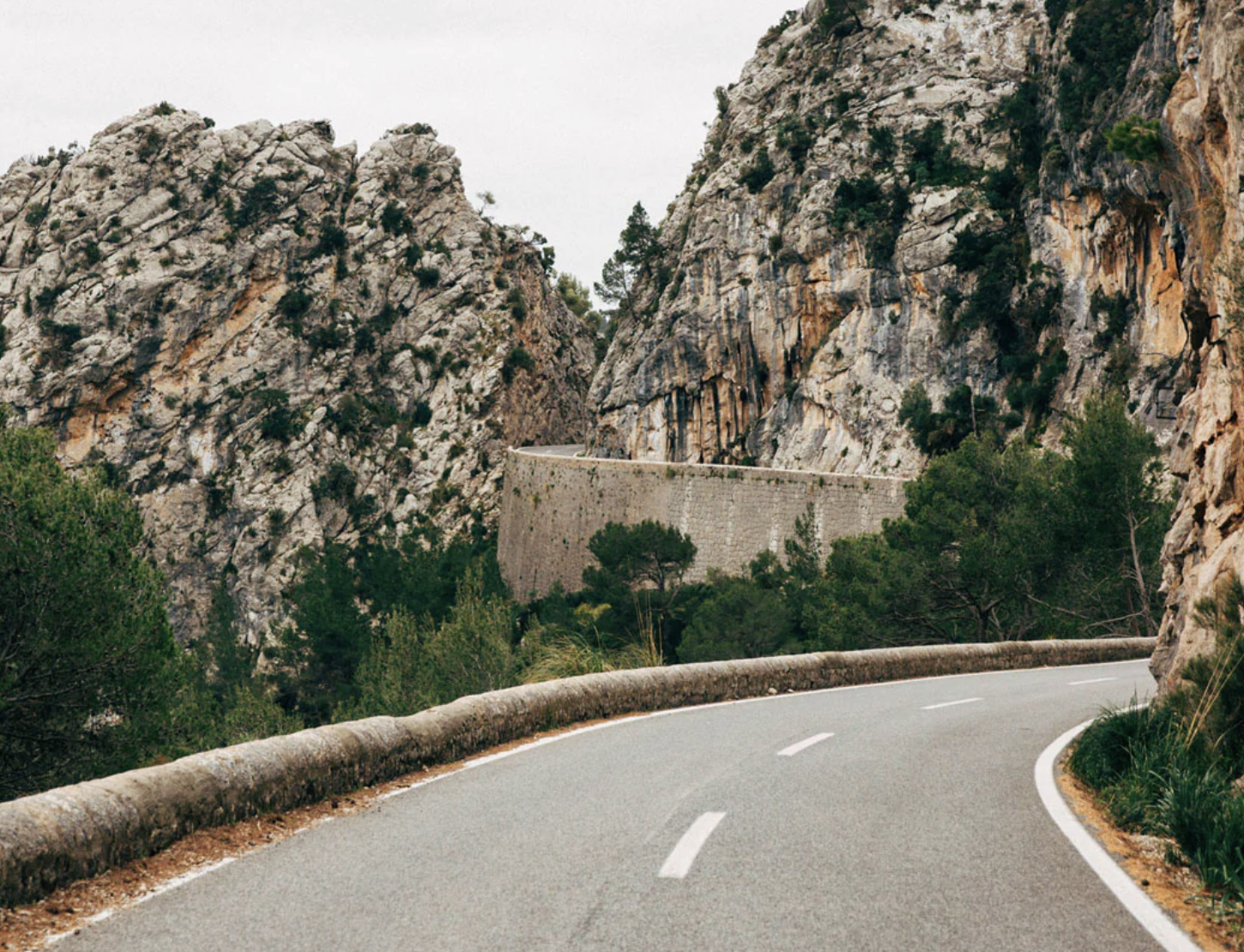
"For every level" gets printed on a lot of cycling holiday brochures without much behind it. Ours has real numbers: Mallorca's climbs are categorized from Cat4 (a few hundred metres of gentle gradient) to Cat1 (sustained, six-hundred-metre efforts), and every Medfeel tour is rated against what it actually asks of your legs, not against how the trip is marketed.
How Medfeel Defines Level
The building blocks are the climbs themselves. A Cat4 climb like Coll d'Honor from Orient (6.2 km, 334 m) sits at the easy end. A Cat1 climb like Coll des Reis, the descent to Sa Calobra (9.5 km, 660 m, average gradient 7.2%), sits at the hard end. A tour's level reflects how many climbs like that it strings together across how many days — which is why the same total elevation spread across seven days feels completely different from the same number squeezed into three.
| Climb | Category | Length | Elevation gain |
|---|---|---|---|
| Coll d'Honor (from Orient) | Cat2 | 6.2 km | 334 m |
| Coll de Soller (north) | Cat2 | 8.9 km | 473 m |
| Coll de Sa Batalla | Cat2 | 7.9 km | 386 m |
| Cap de Formentor | Cat3 | 10.8 km | 309 m |
| Puig Major (from Sóller) | Cat1 | 14.4 km | 815 m |
| Coll des Reis (Sa Calobra) | Cat1 | 9.5 km | 660 m |
Easy: The Easygoing E-Bike Tour
The Mallorca Easygoing E-Bike Tour is Medfeel's only tour rated Easy cycling — seven days, five riding days, 260 km, and 1,450 m of elevation on Trek e-bikes through the Tramuntana foothills. It's the tour we recommend for riders who want the scenery and the climbs without needing to arrive in race form, and it runs as a scheduled group departure, from €1,880.
Intermediate: Four Tours, One Real Range
Most of Medfeel's lineup sits here, and "Intermediate" still spans a wide gap — from a weekend taste to a full week of the island's best-known roads.
| Tour | Days / Riding days | Distance / Elevation | From |
|---|---|---|---|
| Weekend Cycling Escape | 3 / 2 | 130 km / 1,850 m | €950 |
| Classic Bike Short Tour | 5 / 3 | 330 km / 3,290 m | €1,250 |
| Signature Mallorca Bike Tour | 7 / 5 | 430 km / 4,610 m | €2,320 |
| Tramuntana Luxury Ride | 7 / 5 | 455 km / 4,670 m | €4,850 |
Notice the Weekend Cycling Escape and the Tramuntana Luxury Ride carry the same "Intermediate" label despite a 2,820-metre gap in total climbing — that's the range compressed into a weekend versus spread across a full week. Riders who are comfortable on 2-3 solid climbing days but unsure about sustaining that pace for a full week usually start with the Classic Bike Short Tour and build up from there. If you're weighing duration specifically, our how-many-days guide goes deeper on that question.
Experienced: The Epic Island Cycling Loop
The Epic Island Cycling Loop is Medfeel's only Experienced-rated tour — eight days, six riding days, 375 km, and 6,000 m of elevation circling the whole island. It's rated harder than the Tramuntana Luxury Ride despite covering less total distance, because the climbing is packed into fewer riding days at a higher daily average. From €5,850.
What If You're Between Levels?
This is the most common real-world question, and the answer is usually the bike, not the tour. Every Medfeel tour — Easy, Intermediate, or Experienced — can be ridden on an e-bike instead of a road bike, which changes the physical effort without changing the itinerary or the roads. A rider who wants the Signature Tour's route but not its climbing legs can ride it on a Trek Domane+ SLR rather than dropping to the Easygoing Tour. For a deeper look at what's actually adjustable, see our guide to designing a private Mallorca ride.
Still unsure which level fits your group? Tell us honestly how you ride now at Plan Your Trip, and a Medfeel Travel Agent will match you to a tour rather than let you guess.
Frequently Asked Questions
How does Medfeel decide a tour's difficulty level?
By the real climb categories (Cat4 to Cat1) it includes and how they're spread across the riding days — not a generic star rating. A Cat1 climb like Sa Calobra or Puig Major weighs more heavily than several Cat4 climbs on the same day.
Which Mallorca tour is easiest for a beginner cyclist?
The Easygoing E-Bike Tour, rated Easy cycling — it covers 260 km and 1,450 m of elevation on e-bikes over five riding days, the gentlest combination in the lineup.
Which tour is hardest?
The Epic Island Cycling Loop, rated Experienced — 6,000 m of climbing across six riding days, averaging 1,000 m of ascent a day.
Can an Intermediate rider handle the Tramuntana Luxury Ride?
Yes, by design — it's rated Intermediate, the same as the Weekend Cycling Escape, Classic Short Tour, and Signature Tour, though its total elevation (4,670 m) sits at the higher end of that range spread across seven days.
Does riding an e-bike lower a tour's effective difficulty?
Considerably — an e-bike doesn't shorten the climbs, but it meaningfully reduces the physical effort needed to complete them, which is why it's the main lever we recommend for riders between levels.
Are all levels available as both private and group tours?
Not evenly — the Easy-rated Easygoing E-Bike Tour and one Intermediate tour (Tramuntana Luxury Ride) run as scheduled group departures; the rest are bespoke and private by default. See our private-versus-group comparison for the full breakdown.
What exactly is a "private cycling tour" in Mallorca?
A private tour is built entirely around you or your group: you choose the dates, the base town (Pollença, Sóller, Palma, Deià and others), and the number of riding days, and a Medfeel Travel Agent designs the itinerary, hotels, transfers and even café stops around your level and pace. There's no fixed group and no rigid calendar — most of our lineup, aside from the Easygoing E-Bike Tour and the Tramuntana Luxury Ride, runs this way by default.
Is a private tour worth it compared to a group tour?
It's worth it if you want custom routes built around more mountains, more coast or more inland riding; if your group has mixed abilities and you don't want anyone left behind or blown out chasing someone else's pace; or if you're after real privacy — private transfers, boutique hotels, careful logistics. If you'd rather ride in a group, at a lower price point, on fixed dates, a scheduled departure like the Easygoing E-Bike Tour or the Tramuntana Luxury Ride fits better. Our private-versus-group comparison goes deeper on this.
How much does a private cycling tour in Mallorca cost?
It depends on the number of days, hotel category, and whether a private guide is included. As a real benchmark from our own lineup: a 3-day escape starts from €950 per person, a 5-day trip from €1,250, a full 7-day week from €2,320, and our top-end 7-day Tramuntana Luxury Ride from €4,850. Our longest, most demanding itinerary — the 8-day Epic Island Cycling Loop — runs from €5,850. You can also design something more budget-friendly by prioritising routes over hotel luxury.
What's usually included in a private tour?
Across our tours: all hotel nights, daily breakfast, a high-end bike rental (helmet, pedals and device mount included) delivered and collected at your hotel, daily bike insurance, energy bars, gels and salts, GPX files for every route, airport transfers, luggage transfers between hotels, and a dedicated Medfeel Travel Agent. A private on-road guide is available as an optional add-on rather than a default. Flights, travel insurance and lunches/dinners aren't included — only breakfast is, so budget for meals separately.
What's the best base area for a private tour?
It depends what you want to ride. Pollença and Alcúdia in the north balance mountains, flat bay riding and services — a very safe first base. Sóller and Deià sit at the heart of the Tramuntana, ideal if Sa Calobra, Puig Major and Coll de Sóller are the priority. Palma works well if you want to mix some city and culture with rides into the interior or south. As locals: if it's your first time and you want a bit of everything without overdoing it, Pollença or Sóller are the safest bets.
Is Mallorca only for very strong cyclists?
No — it's one of the most versatile cycling destinations in Europe. Alongside the Tramuntana's serious climbs, there's plenty of flat riding around the Alcúdia and Palma bays and gentle rolling roads through the interior. Plenty of guests ride a full week here without ever touching Sa Calobra or Puig Major and still leave thrilled.
What level do I need to enjoy cycling in Mallorca?
Any level, if you choose your routes wisely. Beginner or recreational riders do well on bay loops, gentle interior roads, and first climbs like Cap de Formentor (10.8 km, 309 m, a gentle 2.9% average) or Coll de Sóller from the south (5 km, 258 m, 5.1% average). Intermediate riders can comfortably add Coll de Sa Batalla, Coll de Femenía or Coll d'Honor from Orient, often combining two in one day. Advanced riders take on Sa Calobra and Puig Major, or stack several Cat1/Cat2 climbs into one long mountain day.
What are some genuinely easy routes and climbs in Mallorca?
Flat loops around the Alcúdia bay, with cafés and views and no real climbing; gentle rolling roads through the interior; Cap de Formentor from Pollença (10.8 km, 309 m, 2.9% average — more scenic than brutal); and Coll de Sóller from the south side (5 km, 258 m, 5.1% average), a genuine first taste of a mountain climb without being extreme. Our complete guide to Mallorca's climbs has the full picture, easy to hard.
What do typical intermediate rides look like?
Coll de Sa Batalla (7.9 km, 386 m, 5.0% average, Cat2) is a classic, with a café at the top. Coll de Femenía and Coll d'Honor from Orient (6.2–7.2 km, 330–420 m, both Cat2) are good for building confidence in the Tramuntana. A typical mixed intermediate day pairs one serious climb with coastal or inland riding, totalling roughly 800–1,200 m for the day.
What counts as a "hard" day in Mallorca?
The two big names: Sa Calobra (9.5 km, 660 m, averaging 7.2% with ramps up to around 11–12% near the top) is demanding and committing, especially stacked with another climb. Puig Major from Sóller (14.4 km, 815 m, the island's longest paved climb at a steadier 5.7% average) is less steep but a long, sustained effort. Riding both in the same day is territory for genuinely fit, experienced climbers.
Can I book an Intermediate tour if I've never been to Mallorca?
Yes, and it's very common. Start with easier days — interior, coast — and save the big climbs for mid- or late-week; choose a base like Pollença or Sóller that doesn't force a climb every time you leave the hotel; and use an e-bike if you're unsure, since it's the same route with meaningfully less suffering on the climbs.
What if I'm between two levels?
The usual fix is the bike or the pace, not the destination. An e-bike meaningfully cuts the effort without changing the route — the main lever we recommend for riders between levels. A private tour can also be built with modular variants: climb only partway, skip a climb, or add an extra loop depending on how you feel that day. And alternating a mountain day with an easier inland or coastal day keeps fatigue from stacking up. See our guide to designing a private Mallorca ride for what's actually adjustable.
What's the best time of year to come, by level?
April–May and September–October give the most comfortable riding for most levels: pleasant temperatures and good hotel and rental availability. March can be good but is more unpredictable; July and August are rideable if you handle heat well and start early. Spring and autumn make it easier to mix mountain days in without the heat piling on, especially if you're not arriving in peak form. Our month-by-month guide has the detail.
Do I need to be very strong to ride Sa Calobra or Puig Major?
You don't need to be a pro, but you do need a base level of fitness. A fit recreational rider can climb either at a relaxed pace by respecting the gradient and not attacking the steeper ramps. If you've never tackled a long climb before, it's worth starting with Cap de Formentor, Coll de Sóller or Coll de Sa Batalla and saving Sa Calobra and Puig Major for later in the week, or a future trip.
Is cycling in Mallorca safe for a first trip?
Generally, yes — it's one of Europe's most cycle-friendly destinations, with good road surfaces and a strong culture of drivers respecting cyclists, especially in the Tramuntana and the north. As anywhere, take care on technical descents, in damp or shaded sections, and on busier roads, and always descend within your level. For a first trip, it's worth avoiding the most ambitious climb combinations on day one and building up progressively.
Which tour should I choose, based on my level?
Beginner, or coming back after time off the bike: look for an itinerary that prioritises the interior and coast, with one or two easier climbs like Cap de Formentor or Coll de Sóller (south), and keep the e-bike option open. Intermediate, wanting the classics without blowing up: build a week with one or two serious mountain days — Sa Calobra or Puig Major, not both on the same day — and mix in easier routes the rest of the week. Advanced and looking for a real challenge: stack multiple big climbs into single days and aim for a full Tramuntana traverse — this is exactly what a private tour is built for.
Whatever level you're starting from, the right tour is the one that matches your actual legs, not your ambitions for them. Start the conversation at Plan Your Trip.